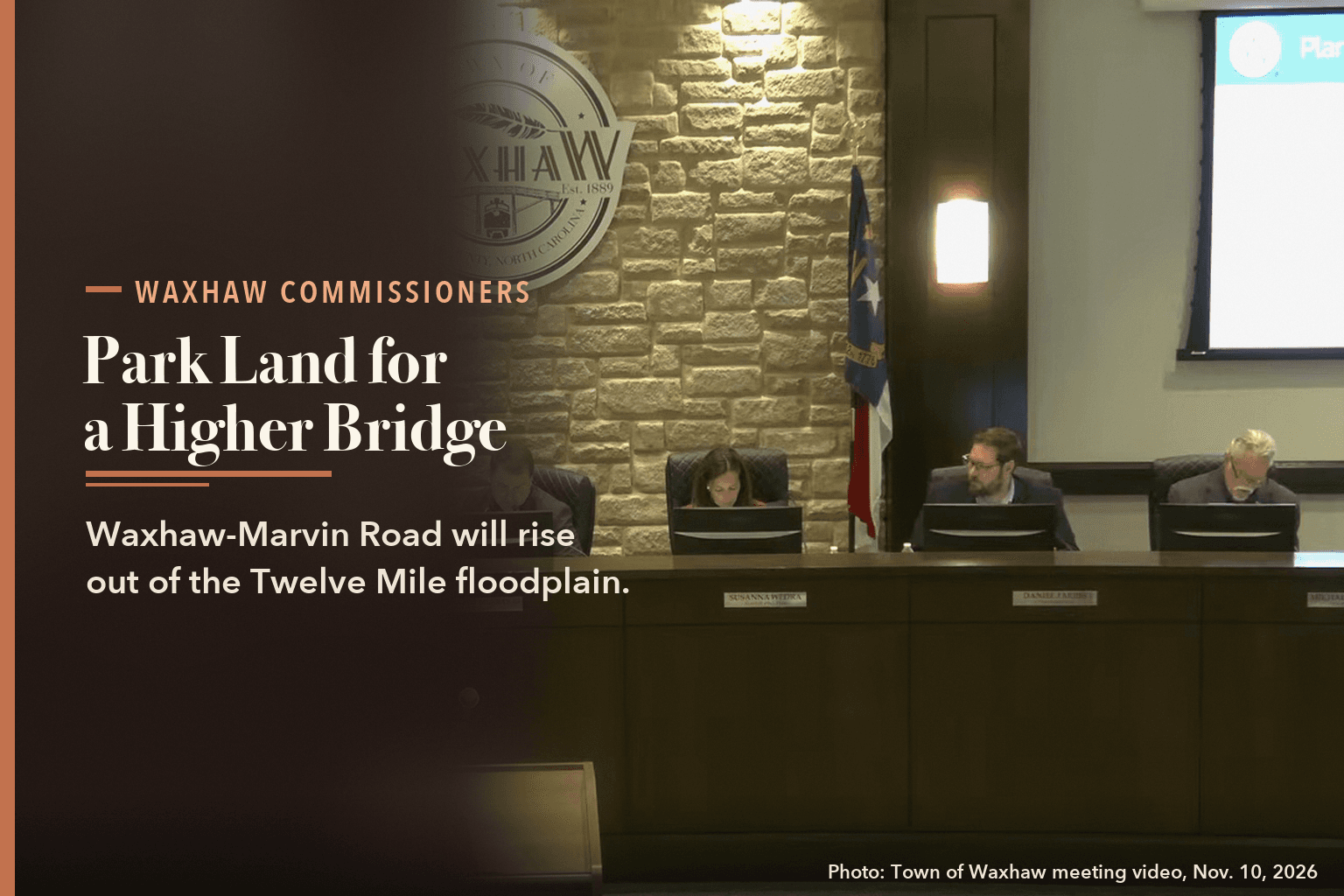
The Waxhaw-Marvin Road bridge over Twelve Mile Creek floods in storms that come every two to five years. The state plans to lift it several feet, out of the 100-year floodplain, and Waxhaw is giving up part of Town Creek Park to make room.
Raising the bridge raises the road on either side, and with it the driveway into the park. The state's first design would have left that driveway at about a 25% grade, town engineering staff told the Board of Commissioners on Tuesday, Nov. 10. The town asked for something closer to the driveway it has now, which staff put at about 12%. The state is redesigning it at a 10% to 15% grade and plans to try a curved drive, staff said.
Staff said the town asked that the design leave the playground where it is, though a couple of parking spaces at the bottom of the hill may be lost or shift.
The board voted with no one opposed to approve an agreement under which the town donates right of way and easements on the park property to the N.C. Department of Transportation for the bridge replacement. The town is not being paid for the land, the agenda says. Staff listed the benefits of coordinating with the state: a greenway path under the new bridge and relocation of the town's fiber lines.
The agreement also commits the town to pay an estimated $126,765, due when it is signed, for extra work Waxhaw requested: $66,817 to widen the bridge three feet for a barrier protecting the multi-use path, $41,679 for a greenway from Town Creek Park toward the Carolina Thread Trail, including the section under the bridge, and $18,269 to extend the multi-use path to the park's parking lot. The cost did not come up at the meeting.
The temporary construction easements return to the town when the work is done. The town also hopes the state can help it add 20 overflow parking spaces in the grass for large park events.
Construction is estimated to start in November 2027 and take about seven months, staff said, though weather or late deliveries could stretch that.
License plate readers
The board also adopted, with no one opposed, a revised policy for the police department's automated license plate readers, cameras that read passing plates and alert officers to stolen cars or wanted drivers.
The policy bars using the cameras for traffic enforcement, facial recognition or other biometric identification, and requires a documented reason for searching past data. Plate data is deleted automatically after 30 days unless it is saved for a case, police told the board, and the department will audit use every 30 days and once a year.
Every officer who completes the training can search the system, but only four can add a plate to a watch list that tracks where it goes, police said in answer to a question from the board. The town's contract for the system runs through December 2028.