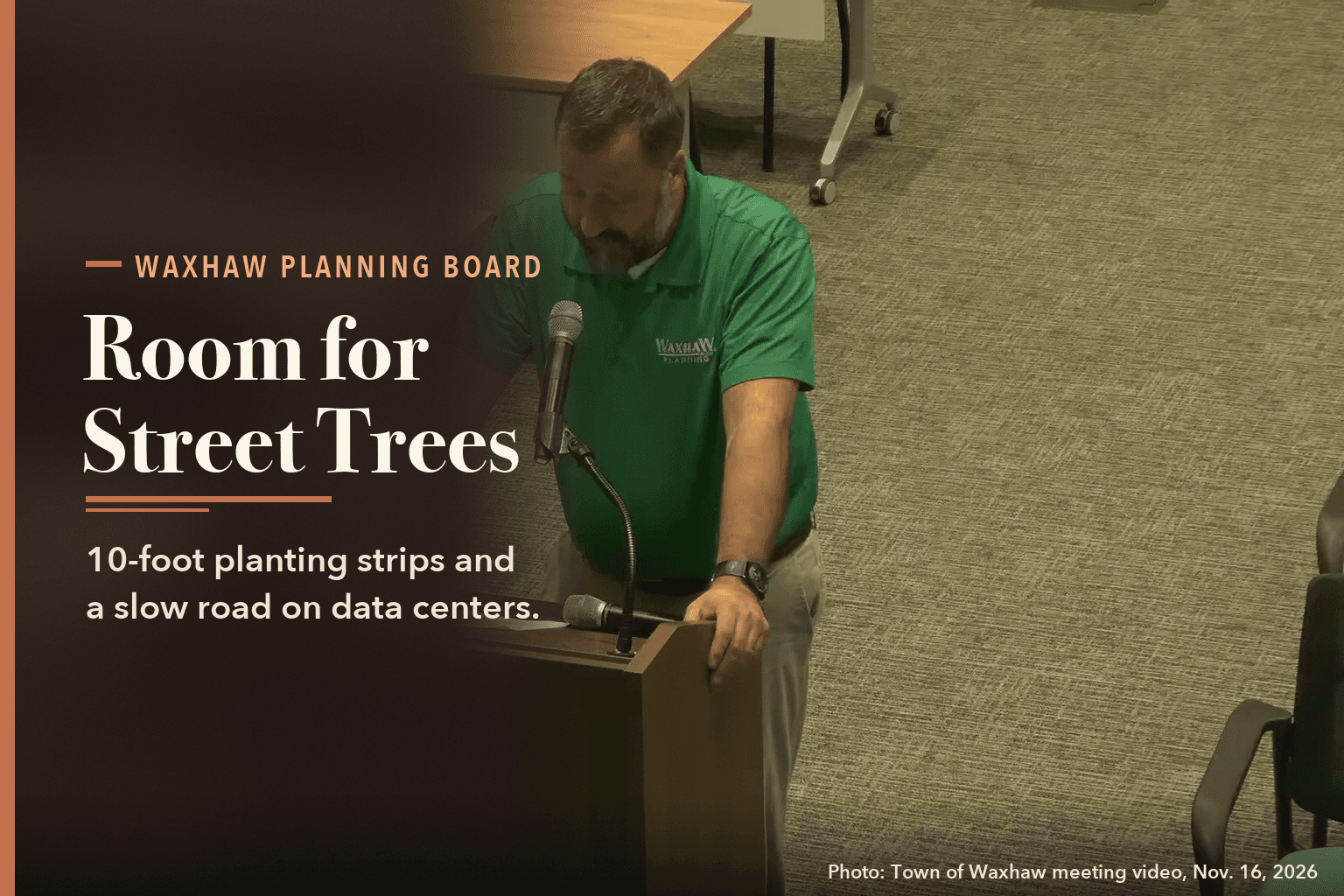
Waxhaw's planners want more room for the street trees in the town's next neighborhoods. They are considering four more feet of public land along each new street, planting strips 10 feet wide and barriers between the roots and the concrete.
Then there are the trees already in the ground. In Cureton and Millbridge, two Waxhaw neighborhoods, "we have a lot of street trees and a lot of them are planted really too close together," Development Services Director Kevin Robinson told the town's Planning Board on Monday, Nov. 16. "So we are going to have to go back and try to carefully fix some of these neighborhoods."
None of it is ready for a vote. Robinson laid out the plans, along with the schedule for new rules on data centers, "so when this stuff comes through to you all, you won't be surprised," he said.
Street trees
"So maintenance is an ongoing task," Robinson said of the two neighborhoods. The previous Board of Commissioners made changes to who is responsible for that upkeep, he said, and staff is looking into it.
Staff is to brief the Board of Commissioners in December on caring for the street trees already planted, across town but chiefly in Cureton and Millbridge. Possible policy changes for existing trees in many subdivisions would follow, Robinson said, so that they "are not too close together, getting crowded and just really becoming a mess." For new development, ordinance changes in the new year would aim to put "the right trees in the right place moving forward," he said, so the town does not reach "another 10, 20 years down the road and have even worse problems."
Those changes would ride in a larger package that would simplify the town's requirements for open space, tree preservation and parks in new subdivisions. "It is really confusing," Robinson said. "I've been doing this stuff for a long time, and when I go in to try to apply our ordinance to a subdivision, it's really difficult to figure out exactly how that happens."
Staff is considering widening the standard right of way on new streets, the band of public land that holds the street, its planting strips and its sidewalks, from 51 feet to 55 feet. Robinson called 55 feet "still probably about average to maybe even below average" for what towns require now. The four extra feet would make room for 10-foot planting strips. Monroe has several neighborhoods with 10-foot strips along N.C. 75, he said, and "10 feet really seems to be the best way to do it from what we found." The package would also call for better tree species and require root barriers at the edge of the concrete.
It would add a "dig once" rule, too. Developers would lay empty conduit in a set spot, probably next to the sidewalk, and phone and internet companies could pay the town a lease to run their lines through it instead of tearing up the ground. Robinson said he could not find another town with such a rule, though "DOT has a dig once policy." Staff hopes to bring the whole package to the Planning Board and the commissioners in February or March.
Planning Board member Rick Kraus asked whether the rewrite would deal with mulch heaped against the base of new trees, a "volcano effect" that he said seems to happen even when the town replaces trees. The rules will be "focused more on placement," Robinson said, not planting practice, though the town will probably need help from the county's arborists.
Data centers
Commissioners put a one-year moratorium on data center approvals this summer. No application to build one was pending in Waxhaw, Mayor Robert J. Murray III said the night they voted. Robinson said staff has posted a page about data centers on the town's website and written two short surveys for FlashVote, an online survey service; the first has gone out and the second is to go out next month.
Staff plans to take the results to the commissioners in January and February for their first guidance, then bring draft options to both boards, probably between March and May. "I think they're really wanting to kind of take this, take their time and slow walk this one a little bit, make sure we get it right," Robinson said. The advantage, he said, is "we're seeing what everybody else is doing and we're not going to be the guinea pig out there."
The goal is a rule ready for the commissioners to consider next summer, two to three months before the moratorium runs out, he said. Commissioners could add time to the moratorium, he said, though he was not sure of the legal limits; it is only the second moratorium he has been involved in considering.
What other towns require varies widely. Asked by a board member whether studies of electricity, heat and noise would be needed, Robinson said, "It doesn't have to be, but that's what a lot of the ordinances are requiring now." Staff keeps a spreadsheet comparing towns' rules. "It's all over the place," he said. Some ask for little; others "require the kitchen sink."
Kraus asked whether his board should be doing more. Advising on policies like this one is part of its job, he said, "but for months we haven't been involved at all, so far as I know." He called it "total silence."
The Planning Board will have to weigh in, Robinson told him, because the rule is a change to the town's land development ordinance. Kraus then put the question to his colleagues: be more proactive, or wait until staff and the commissioners "decide to loop us in." Members are free to look into it on their own, the chair said, but until then, "we would rather wait."
The commissioners have taken a more active role at the start than usual, Robinson said, and he put that down to "just the political nature of it." After he presents to them in January and February, he said, he plans to be back before the Planning Board "to really start kind of digging into it a little bit," and "there will be ample opportunity."