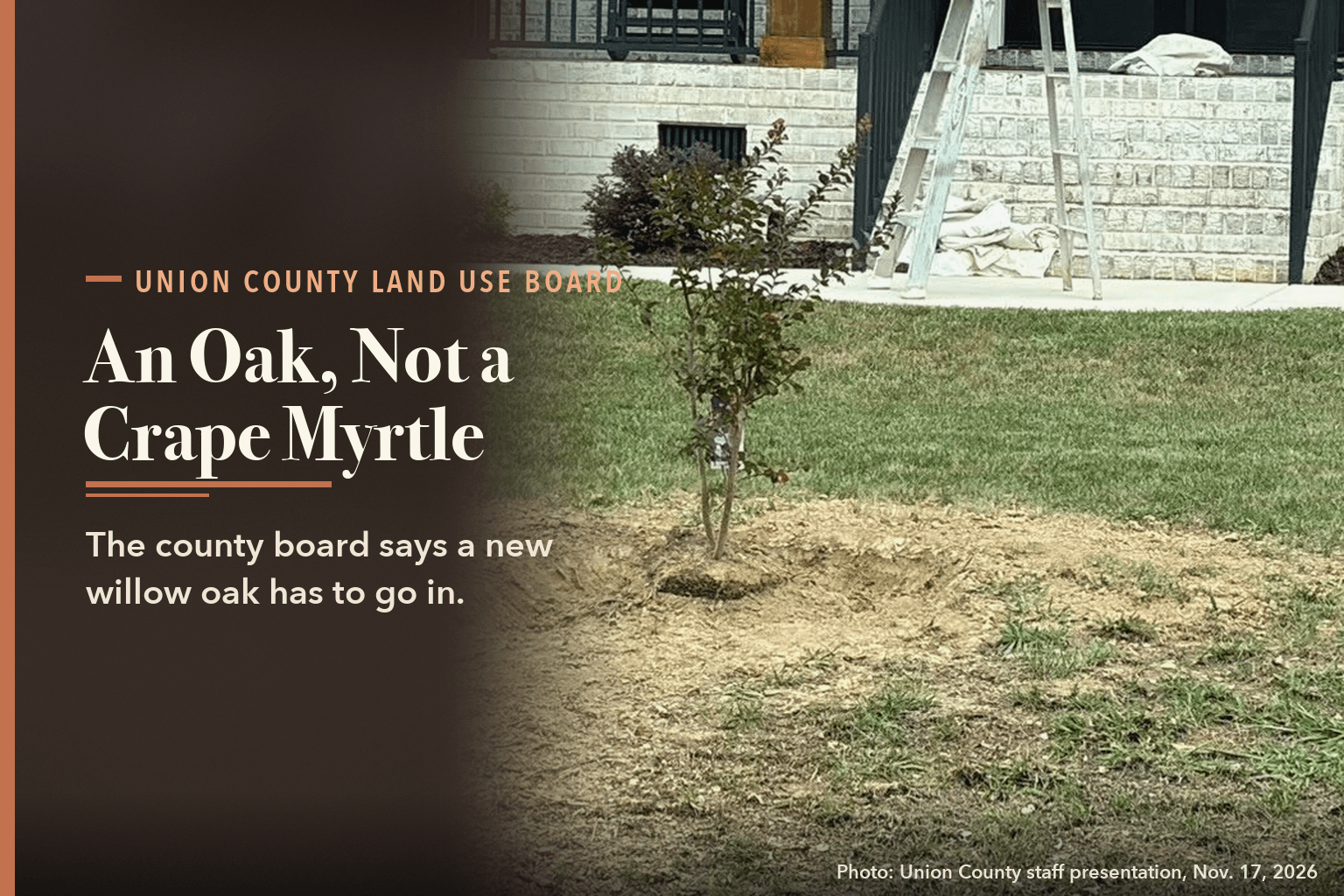
Amy and James Haislip took down the willow oak in front of their house near Monroe and planted a crape myrtle. On Tuesday night, Union County's Land Use Board said a willow oak has to go back.
The oak was one of the trees the developer planted along Martha's Meadow Lane, a cul-de-sac of five homes, because the county requires new subdivisions to line their streets with trees. The board upheld the county's notice of violation, which calls for a new willow oak at least 8 feet tall, with a trunk at least 2.5 inches across. Nearby Waxhaw, which sets its own rules, is weighing wider planting strips for the street trees in its next neighborhoods.
Much of the hearing turned on a question any owner in a new subdivision might ask. "How are we as homeowners supposed to know those trees can't be removed?" James Haislip asked the board. Nobody told them at closing, the couple said, and the plat they were given, the recorded map of the lots, showed no trees.
The board was also thinking about the rest of the street. Asked whether the other trees stood as far from the houses as theirs had, James Haislip said they did, and that the neighbors would "love to have their trees taken down too." If one owner got by with it, a board member said, the others would follow, and the plat the zoning department works from would be "no good anymore."
It was the second tree to come down on the lot. The first, near the driveway, drew a citation in February. John Wear, the county's zoning administrator, closed that case in August because the tree had stood so close to the driveway and the couple had since planted crape myrtles and arborvitae. That notice had told them to "replant an approved tree back," Amy Haislip said, and she assumed the same fix would cover a second tree.
As the first case was closing, she emailed Wear to ask whether they could take down another tree "due to the fact that it's a big ugly oak tree in the center of our yard," and plant a crape myrtle instead. Wear, who read the email to the board, wrote back that he could not advise it. Asked for a list of approved trees, he pointed her to those found in USDA hardiness zone 7b, an answer he said he gave because she had called her question separate from the case. She took it as a list to choose from, and a crape myrtle was on it. A complaint that the oak had been cut down came in on Sept. 1.
The couple's main argument was that the oak was not a street tree at all. The county's rule puts street trees no more than 15 feet from the edge of the right-of-way, the public land the road sits on. With neighbors' help, Amy Haislip said, they measured the oak farther back than that, "which then makes it a yard tree, not a street tree." Their next-door neighbor said his own trees also stood beyond 15 feet, and that the county should mark required trees on the plans so owners know.
Wear said he had not measured the spot, and that the right-of-way is often measured from the center line of the road, a starting point many people do not know. The trees as drawn on the plan sit where the county would never have approved them, he said, because it does not allow trees in the right-of-way. Placing street trees is "maybe not an exact science," he said; staff mainly check that the right number stand in the part of the yard where they belong.
The developer, Ed Papworth, said the trees went in before any house was built, exactly where the county-approved plan shows them, "within an inch." The subdivision is named for his daughter Martha, who died. "Martha was a tree hugger," he said. He said he had told the Haislips before they bought the lot that they could not cut the street trees: "They were plainly told in the King's English." A board member stopped him to remind him he was under oath, saying the board was hearing "two totally different stories."
The Haislips said what Papworth told them was that big oaks on another lot they looked at first could not come down, because of his daughter. No one mentioned a county rule, they said, and James Haislip did not remember being told anything about the street trees. "We're just trying to beautify our property, not have problems with it later on down the road," James Haislip said. Asked whether they would plant a willow oak and end the case, the couple said they would rather not. That, a board member replied, was "not an option, though, according to the ordinances."
The board's attorney, Kelly Cope, told members the only question was whether the notice was right under the ordinance. Hardship and appearance, Cope said, belong in a request for a variance, an exception to the rule, which is a separate process.
Mark Tilley, a board member, said he would not want the tree in front of his own door either, and hoped the couple might be allowed to set the new one a little to the side. He then moved to uphold the violation, without that change, saying Wear had done his job and that there could have been "a lot better communication from the other side." The motion did not address the 15-foot argument. It carried on a voice vote, and no opposition was heard.
"The rules are rules and we all have to live by them," said the board's chairman, Darren Greene. Upholding them in a hard case, he said, is "one of the hardest jobs we do on this board."
The board was told its written decision would probably be adopted at its December meeting and mailed after it. The Haislips will then have 30 days to appeal to Union County Superior Court, the chairman told them.